You may also like:

Related Posts Plugin for WordPress, Blogger...

El Topo, 1971

This violent and allegorical Mexican western attracted a cult following in its day. It is the story of El Topo, a gunslinger who sets out for revenge against the outlaws who slew his wife. ...

Faster Pussycat Kill Kill (1965)

Exploitation maven Russ Meyer created a cult classic with this turbo-charged action film. Three curvaceous go-go dancers in a cool sports car go on a desert crime spree, led by Varla (the amazing Tura Satana), a busty, nasty woman dressed entirely in black.

L'uccello dalle piume di cristallo (The Bird With the Crystal Plumage) (1969)

This trend-setting thriller put its director, Dario Argento, on the international map and began a flood of imitative mystery-horror hybrids which dominated Italian genre output in the early 1970s.

Gojira (1954)

One of the longest-running series in film history began with Ishiro Honda's grim, black-and-white allegory for the devastation wrought on Japan by the atomic bomb..

MAD MAX (1979)

This stunning, post-apocalyptic action thriller from director George Miller stars Mel Gibson as Max Rockatansky, a policeman in the near future who is tired of his job.

Showing posts with label 1980s. Show all posts

Wednesday, June 5, 2013

Pink Floyd - The Wall (1982)

Inspired by Pink Floyd's album of the same name, Pink Floyd: The Wall is a dark, expressionistic musical, told from the point of view of Pink, a depressed rock musician. The film is structured around Pink's reflections on his life, all of which center on the building of "the wall." This wall is a metaphor for psychological isolation, a barrier Pink creates to distance himself from his pain. 

The foundations for this wall are lain in childhood, with the death of Pink's father leaving him to be raised by an overprotective mother and a repressive school system. He seeks freedom from this world through writing and music. However, even after he achieves success as a rock star, the wall continues to grow, with Pink feeling trapped by fame and wounded by his failed personal relationships. Lost in despair and self-loathing, he attempts to isolate himself from the world entirely. Director Alan Parker approaches this material in a highly stylized manner, mingling animation and dream-like sequences to suggest Pink's perception of the world. These techniques complement the almost constant music, which the film often uses in place of dialogue. Songs include "Another Brick in the Wall" and "Comfortably Numb". ~ Judd Blaise, Rovi (http://www.rottentomatoes.com)

R,
Alan Parker
Roger Waters
Free movie thanks to:  Vitaly Yurchenko

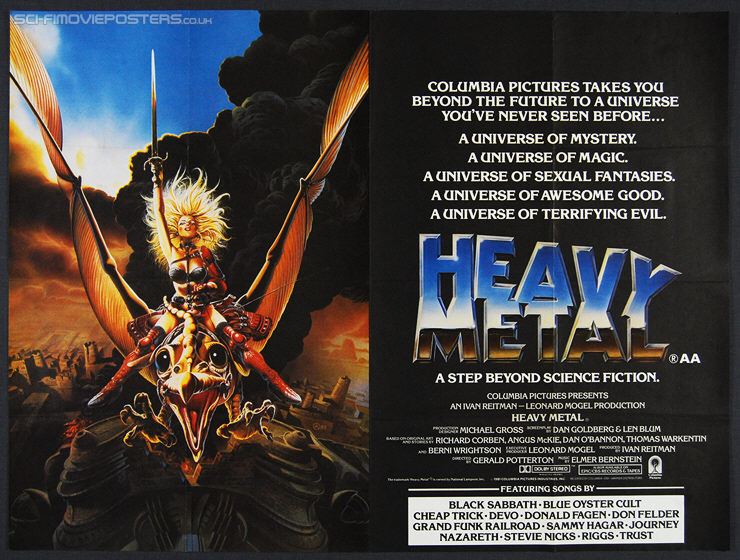
Heavy Metal (1981)


Inspired by stories from the fantasy graphics magazine Heavy Metal, this five-part animated feature combines the talents of hundreds of artists and animators from 17 different countries. A glowing green orb called Loc-Nar that contains the sum total of all evil in the universe travels through space and time, spreading violence and discord in its wake.


The stories that follow demonstrate Loc-Nar's malevolent presence throughout the universe. In New York in the year 2023, cabbie Harry Canyon picks up a fare who turns out to have Loc-Nar in her possession, and it turns out to be one trip he wishes that he had never made. In contemporary suburban America, a nerdy high school kid finds the orb in his backyard and is transported to a comic-book universe where he's a mighty warrior and famous spoiler of women. A robot created by an alien race falls in love with a secretary from Earth who was kidnapped by his masters, while she is at once fascinated and repelled by his sexual talents. And finally, Loc-Nar crashes into a mountain, and a world of fantasy and danger spontaneously appears in its wake, ruled by The Defender, a beautiful amazon who rides on a giant bird. The voice cast for Heavy Metal includes John Candy, Harold Ramis, Joe Flaherty, Eugene Levy, Richard Romanus, and John Vernon. The sound track features selections by Black Sabbath, Blue Oyster Cult, Nazareth, Cheap Trick, Devo, and Grand Funk Railroad. ~ Mark Deming, Rovi

R,
Gerald Potterton , Jimmy T. Murakami
Len Blum, Dan Goldberg
Free movie thanks to: Skeletor Rathbone

Monday, April 22, 2013

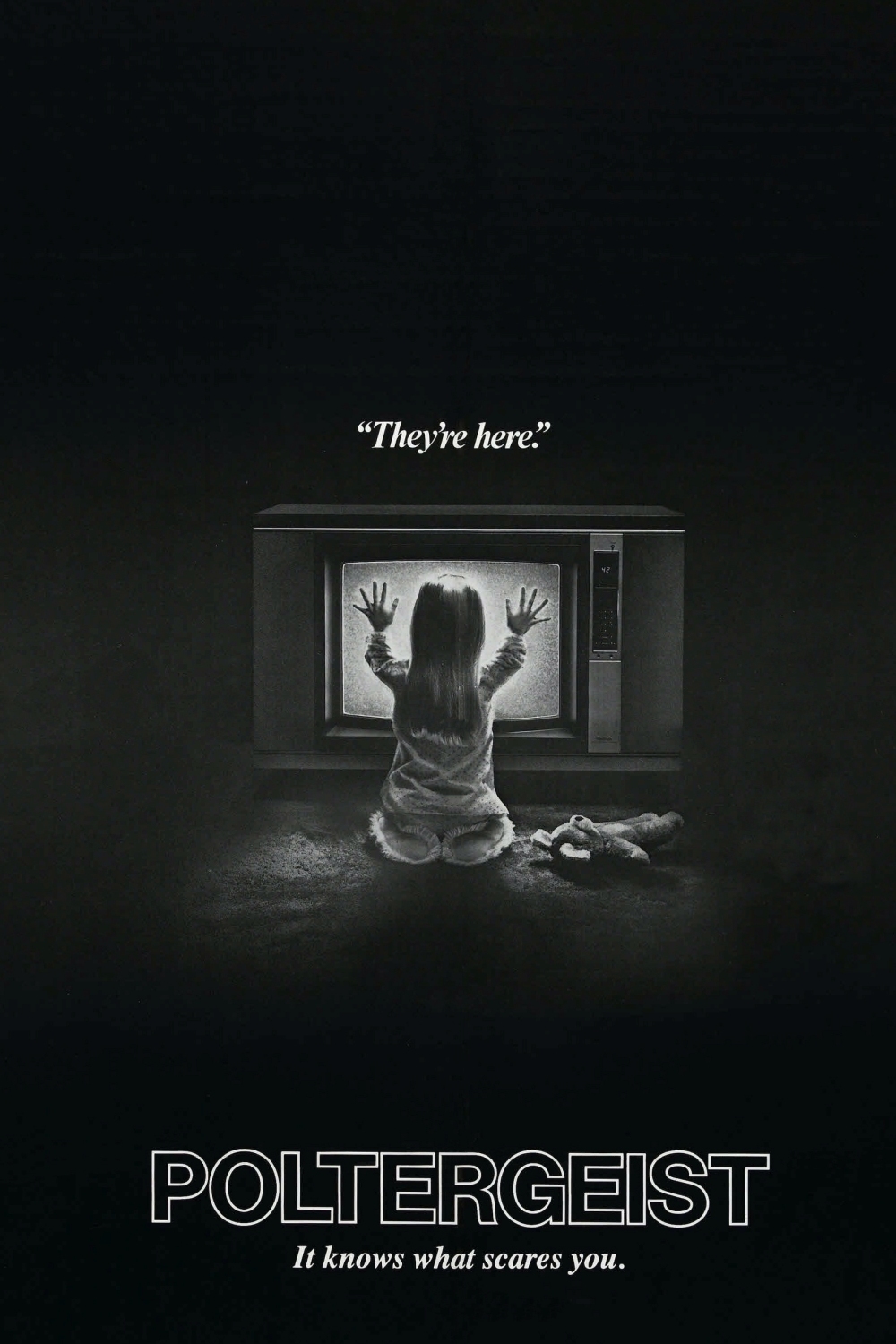
Poltergeist (1982)

With Poltergeist, directed by Tobe Hopper, Steven Spielberg had his first great success as a producer. Released around the same time as Spielberg's E.T., the film presents the dark side of Spielberg's California suburban track homes. The film centers on the Freeling family, a typical middle class family living in the peaceful Cuesta Verde Estates. The father, Steve (Craig T. Nelson), has fallen asleep in front of the television, and the dog saunters around the house revealing the other family members -- Steve's wife Diane (JoBeth Williams), sixteen-year-old daughter Dana (Dominique Dunne), eight-year-old son Robbie (Oliver Robins), and five-year-old Carol Ann (Heather O'Rourke). Soon strange things begin to happen around the house; the pet canary dies, mysterious storms occur, and Carol Ann is summoned to the TV set, where a strange shaft of green light hits her and causes the room to shake ("They're he-e-ere!"). As curious events continue, Carol Ann is repeatedly drawn to the television, where she begins to talk to "the TV people." Soon Carol Ann is sucked into a closet, disappearing from this reality plane. Unable to find his daughter, Steve consults Dr. Lesh (Beatrice Straight), a para-psychologist from a nearby college. Lesh finds that paranormal phenomena is so strong in the Freelong household she is unable to deal with it and sends for clairvoyant and professional exorcist Tangina (Zelda Rubinstein) to examine the house in hopes of finding Carol Ann. Tangina makes a horrifying discovery: Carol Ann is alive and in the house, but is being held on another spectral plane. ~ Paul Brenner, Rovi (http://www.rottentomatoes.com/)


PG, 1 hr. 54 min.
Horror
Tobe Hooper
Michael Grais, Mark Victor, Steven Spielberg


Sub Movie

Saturday, April 20, 2013

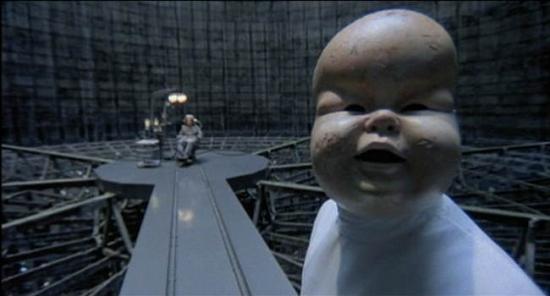
Brazil (1985)


Brazil constitutes Terry Gilliam's enormously ambitious follow-up to his 1981 Time Bandits. It also represents the second installment in a trilogy of Gilliam films on imagination versus reality, that began with Bandits and ended in 1989 with The Adventures of Baron Munchausen. To create this wild, visually audacious satire, Gilliam combines dystopian elements from Orwell, Huxley and Kafka (plus a central character who mirrors Walter Mitty) with his own trademark, Monty Python-esque, jet black British humor and his gift for extraordinary visual invention. 

The results are thoroughly unprecedented in the cinema. Jonathan Pryce stars as Sam Lowry, a civil servant who chooses to blind himself to the decaying, drone-like world around him. It's a world marred by oppressive automatization and towering bureaucracy, and populated by tyrannical guards who strongarm lawbreakers. And Lowry is stuck in the middle of this nightmare. Whenever real life becomes too oppressive, Sam fantasizes (to the tune of Ary Baroso's 1930s hit "Brazil") about sailing through the clouds as a winged superhero, and rescuing beautiful Jill Layton (Kim Greist) from a giant, Samurai warrior. The omnipresent computer that controls everything in the "real" world malfunctions, causing an innocent citizen to be arrested and tortured to death. When Sam routinely investigates the error, he meets - and pursues Jill , literally the girl of his dreams. But in real life, she's a tough-as-nails truck driver who initially wants nothing to do with him. It turns out that she is suspected of underground activities, in connection with a terrorist network wanted for bombing public places. The price Sam pays for his association with her is a close encounter with the man in charge of torturing troublesome citizens (Michael Palin). He is rescued - at the last minute - by maintenance man Harry Tuttle (Robert de Niro) who moonlights as a terrorist, but that only represents the beginning of his plight, for now the "system" is onto him. Gilliam ran into enormous problems with Brazil. Universal - which produced the picture - originally slated it for release in 1984, but the studio - intimidated by the film's whopping length of 142 minutes - demanded that Gilliam trim the film to bring it in under two hours and alter the pessimistic ending. Gilliam refused; Universal shelved the picture for a year. In response, the director took out a full page ad in Variety asking studio president Sid Sheinberg when the film would be released. Sensing tremendous pressure, Universal bowed to Gilliam's insistence on fewer cuts but still demanded a happy ending. Gilliam trimmed only eleven minutes and altered the conclusion just slightly (instead of cutting to black, it fades into puffy white clouds on a blue sky, with a reprise of the title tune). It was thus released in early 1985 at 131 minutes, and of course became a seminal work; many critics regarded it at the time as the best film of the eighties. ~ Nathan Southern, Rovi (http://www.rottentomatoes.com)

R, 2 hr. 11 min. 
Drama, Science Fiction & Fantasy, Comedy 
Directed By: Terry Gilliam
Written By: Terry Gilliam, Tom Stoppard, Charles McKeown
In Theaters: Feb 20, 1985

See the entire film here for free:

Twitter Delicious Facebook Digg Stumbleupon Favorites More